Friday, April 26, 2019

Traveling in France #1 (Part 4 of 6)

Our trip to Normandy continues.  

After visiting Honfleur, we headed to the Normandy beaches, where the Allies landed on June 6, 1944, D-Day.  This year marks the 75th anniversary of D-Day.  

Our guide, who grew up in Normandy, was extremely knowledgeable about WWII history, including why the Allied Powers chose the Normandy beaches to continue the Liberation of France.  We learned a lot and even saw some remnants of German fortifications and the invasion force.  

We first visited Omaha Beach, where a large U.S. force landed on June 6, 1944.  While heavily fortified, the Normandy beaches were concerned to be the weakest point.  The beach is incredibly long and, depending on the tide, extremely wide.  
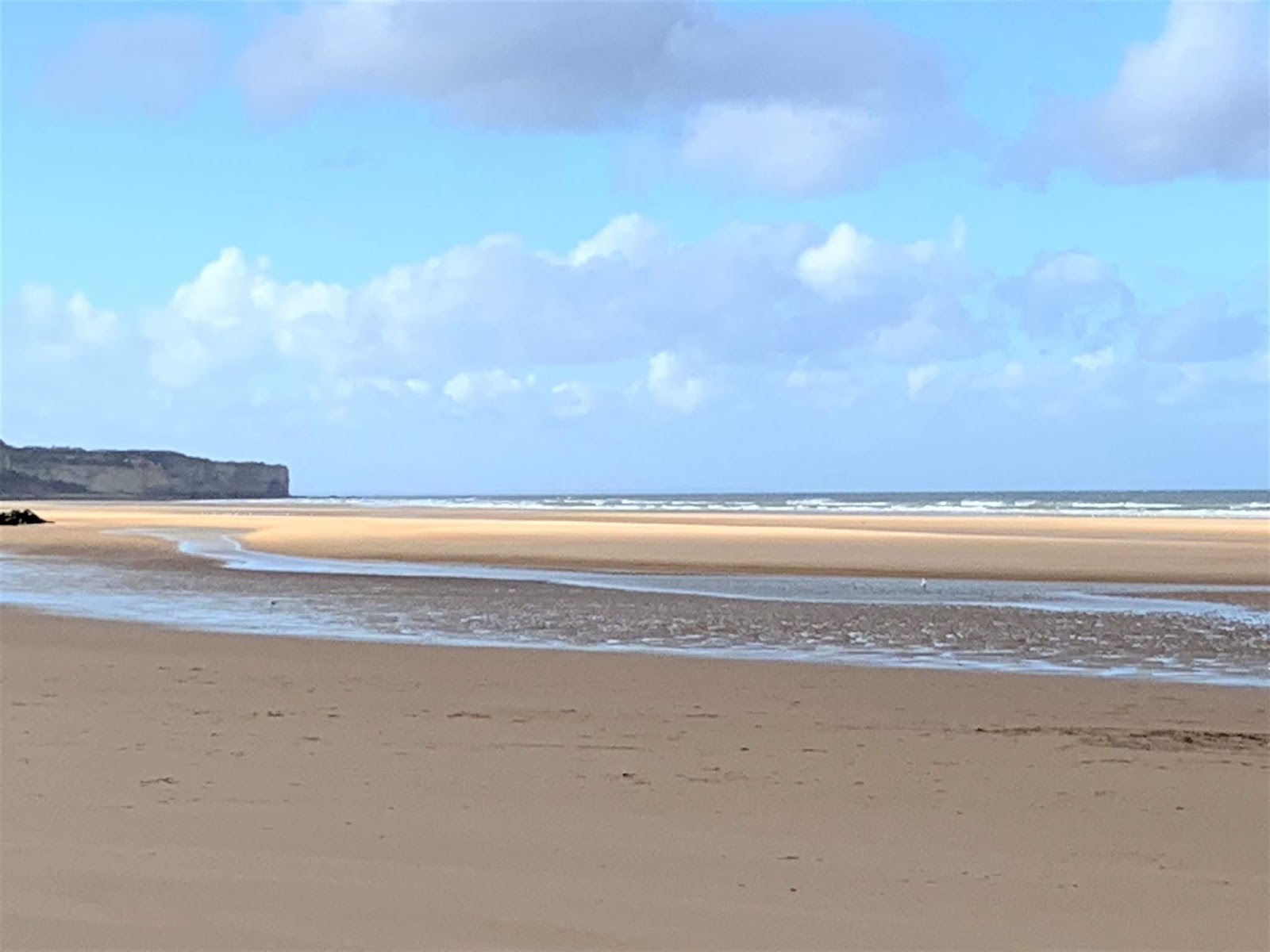

We arrived at low tide and were fortunate enough to see a rainbow.       


At Omaha Beach are many memorials and small museums.   Below are photos of two very large memorials.


We also visited the coastal town of Arromanches, the site of Port Winston, the temporary harbor where the Allies landed supplies for the armies trying to advance inland toward Paris.  Below is a diagram in bronze depicting (a) the ring of concrete ships that were sailed from England and sunk as a breakwater to calm the inner harbor for unloading soldiers, armaments and supplies and (b) the pier and floating bridge connecting the pier and the beach.  


Here is a better image from DDay.Center.  


You can still see pieces of the temporary harbor on the beach and in the ocean.


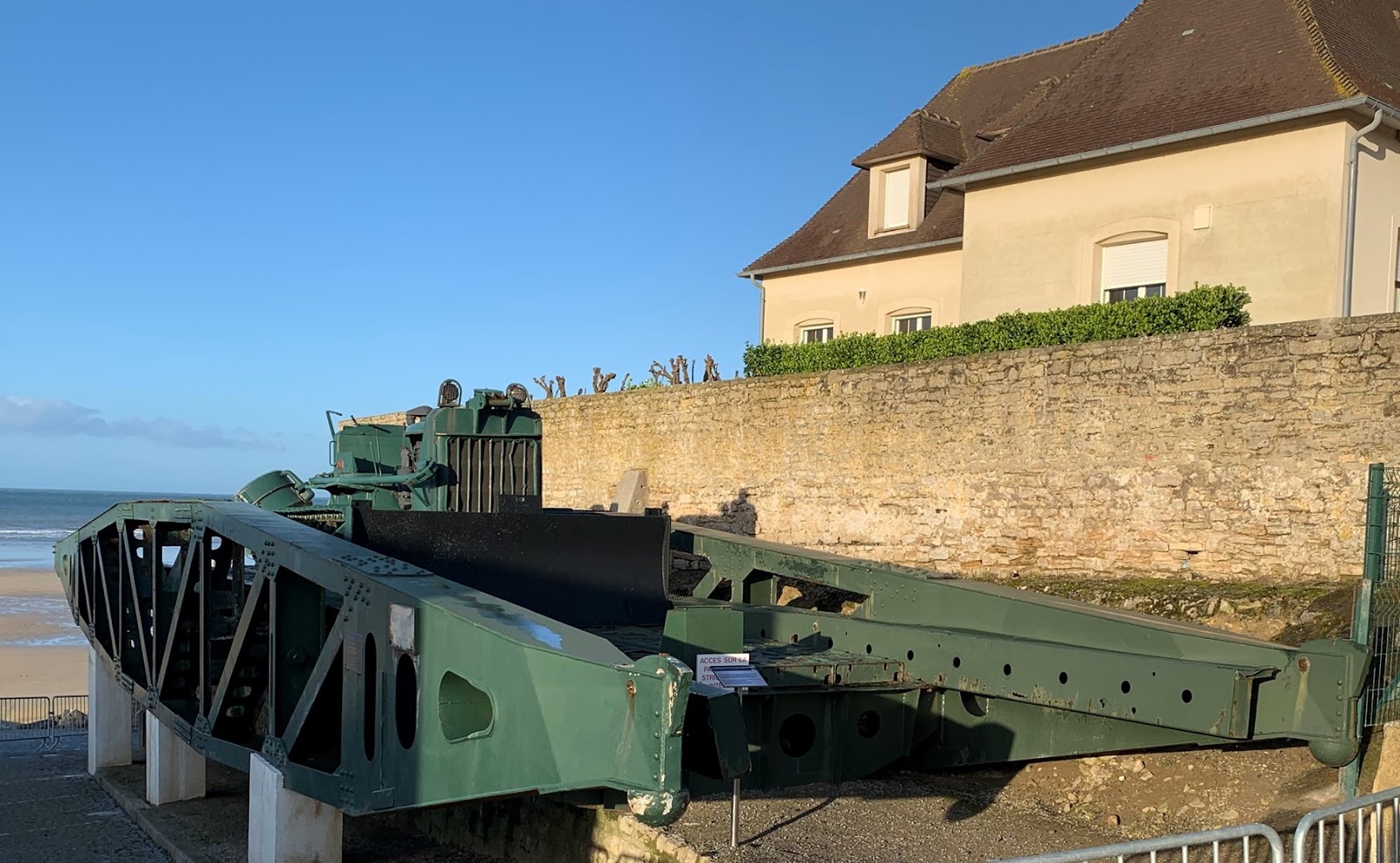
Also at Arroamanches are some of the guns and tanks used during the battle of Normandy.


A tank on top of a German reinforced bunker
We also visited the Normandy American Cemetery and Memorial at nearby Colleville-sur-Mer.


The cemetery is located on a bluff overlooking the Omaha Beach and the ocean beyond.  We learned that the casualty rate for the first wave of our troops in the early morning on D-Day was 90%.  By the end of the day, the casualty rate was 10%.


At the Memorial:  A statue "Spirit of American Youth Rising from the Waves"

In the Chapel:  The altar 

At the Visitor Center:  An infinity pool and a map of Operation Overlord 
At the Memorial:  A map of the landings

The visit to the cemetery was somber because it represents war, sacrifice and death.  Still, the cemetery has some beauty, like the lovely trees and flower beds.


Later in the day, we traveled toward Caen and saw more sights along the way. 

In the nearby town of Bayeuz is a memorial commemorating historic General de Gaulle's visit on June 14, 1944.
We also saw a tank and two of the many German bunkers near the beaches.


We even saw another rainbow.  It was a good day.


Next Up:  St. Malo

Thursday, April 25, 2019

Traveling in France #1 (Part 3 of 6)

Our trip to Normandy continues.

After visiting Rouen, we headed toward the very old port of Honfleur.  To get there, we had to cross the mouth of the Seine where it empties into the English Channel.  We crossed the graceful Pont de Normandie (Normandy Bridge), completed in 1995.  


Honfleur is picturesque and historic.  Because of its strategic importance as a seaport with river access to Paris, it has been held by the Normans, English, French and Germans over the centuries.  It played important roles during the Hundred Years War and during the colonization of North and South America.

We enjoyed a walking tour around the very picturesque town.

The harbor in Honfleur, with a Norman drakkar (dragon boat)
A gate into the old town


A memorial to Samuel de Champlain who sailed from Honfleur to explore North America in the early 17th century. 

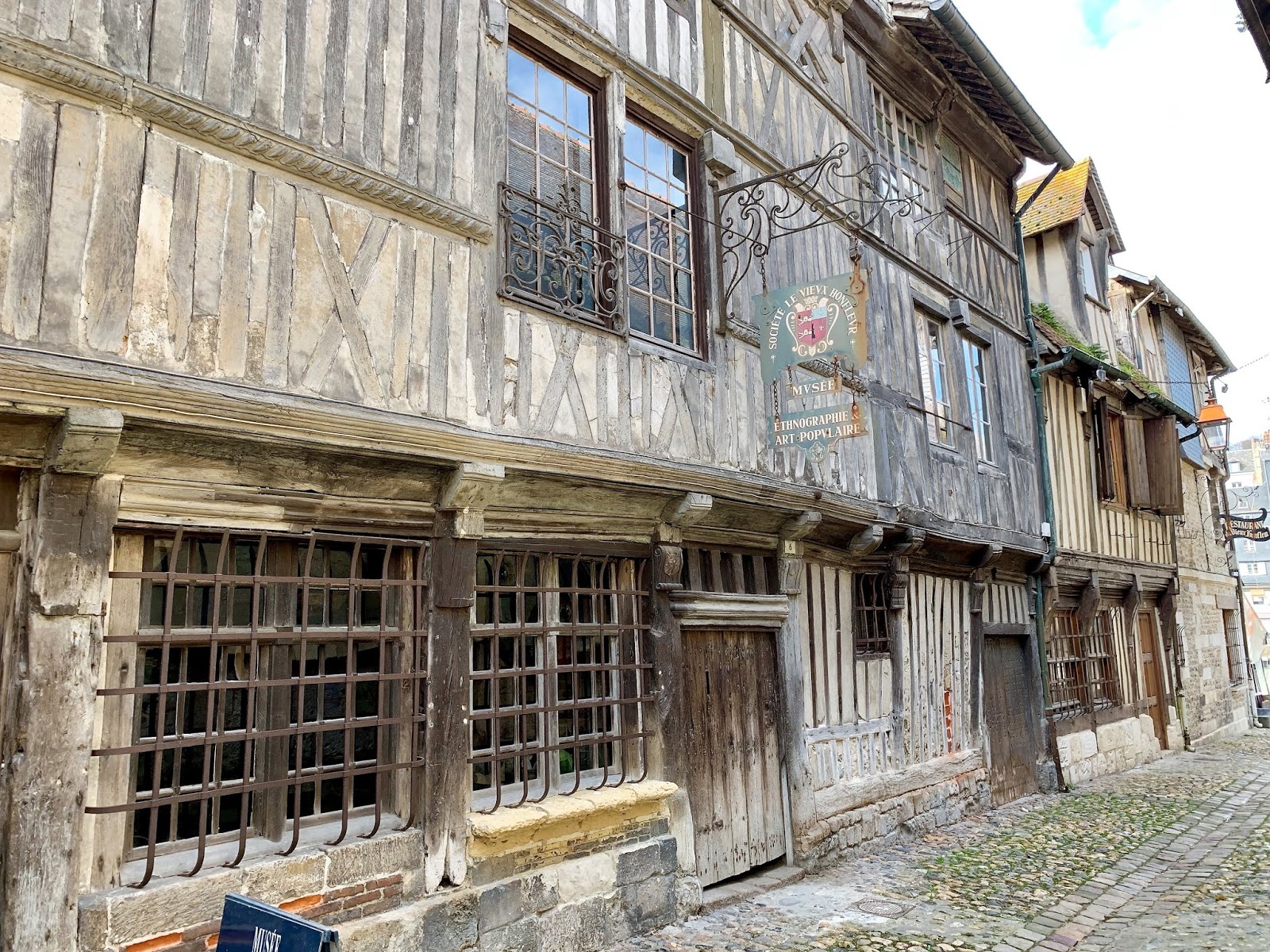
A half-timbered building houses the Museum of Old Honfleur 

The Town Hall of Honfleur
Below is a group of photos of the Church of Saint Catherine in Honfleur, first constructed in the 15th century.  The bell tower (pictured below) is separated from the church to reduce the risk of lightning striking the tall bell tower and fire spreading to the church.  


The facade of the church, which is constructed primarily with wood.
The church has two naves constructed at different times.  The builders of the church were also skilled boat builders, which explains why the wooden roof looks like the hull of a boat.


One of the church's main altars.  The nautical theme of Honfleur is evident throughout the church.
Another view of the church, with its very tall spire.


While walking around the town, we spotted a recent discovery, a small winged person.  Apparently, during the town's early period, houses were identified not by street numbers but by symbols on their facades, like the winged person below.


When we toured the town, we were surprised to see a "Christmas Market" operating months after Christmas and an ice rink with artificial ice.  Greg asked Susan to push him around the rink.  No luck.


One of Honfleur's favorite sons was 19th landscape painter Eugène Boudin.  Boudin is known for his own paintings as well as for encouraging a very talented young painter who was then known as Oscar.  Two of Oscar's paintings of scenes in Honfleur appear below.
   
La Rue de La Bavolle at Honfleur by Claude Monet (1864)

The Entrance to the Port of Honfleur by Claude Monet (1867)
Next Up:  The Normandy Beaches.

Wednesday, April 24, 2019

Traveling in France #1 (Part 2 of 6)

Our visit to Rouen continues.

Rouen had an important role during the Hundred Years' War between the English kings and the French kings (1337-1453).  One episode involved the trial and execution on May 30, 1431 of Joan of Arc.  The English and the Burgundians were afraid of Joan's ability to inspire the French king and military forces.  So, after capturing her during a battle, she was transported to Rouen and tried for repeated heresy.  The outcome, however, was pre-ordained and she was convicted and burned alive.

Big mistake.  Joan of Arc was considered a martyr and became a lasting symbol of French independence.  Eventually canonized in 1920, Sainte Jeanne d'Arc is a patron saint of France.  (You can learn more about Joan of Arc's life by clicking here.)

Below, a tall cross marks the place in Rouen where Joan of Arc was executed.


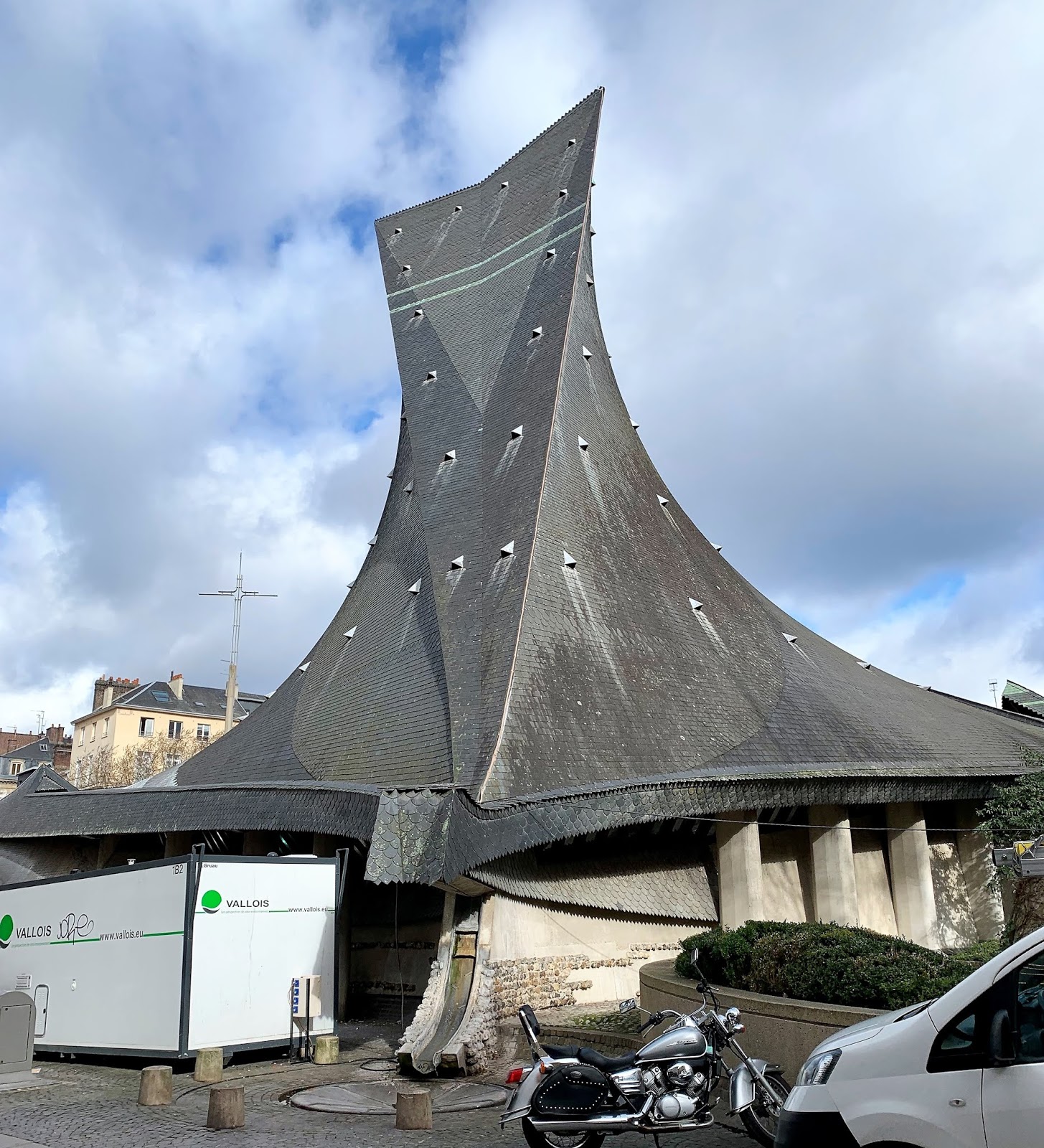
Next to the cross stands a tall, modern church dedicated to Joan of Arc, completed in 1979, L'église Sainte-Jeanne-d'Arc.  The church resembles a dragon, reminiscent of the Norman history of Rouen, when Nordic invaders conquered the region using their viking drakar, dragon boats.  In the photo below, we see the dragon's tall head and its gaping mouth (next to the white truck).


Below is a photo of the entire exterior of the church with the dragon's head and long body.


So, what does a viking drakar look like?  Below is a modern replica.


The nautical theme continues inside the wooden church with its curved ceiling resembling the ribs of a ship's hull.  


The church's interior is ultra-modern with a semi-circular shape and very tall stained-glass windows.


Below is a bust in the church depicting Joan of Arc.


In Rouen, we learned a lot about Joan of Arc.  We also learned they know doughnuts in Rouen.  So, if you are a glutton, you could eat your fill.  


Ironically, they also know vacuum cleaners in Rouen.  Check out the "Glutton" below.


Thanks for visiting Rouen with us.

Next Up:  Honfleur