Saturday, March 25, 2017

Jewish Tuscany (Part 2 of 2)

During the visit of Susan from Houston, we were strolling casually in Florence when we happened upon a temporary exhibit.  The exhibit focused on the lives of Jews in Tuscany during the last and current centuries.  It was hosted in the Palazzo Medici Riccardi.  The exhibit was well researched and very informative, covering many aspects of Jewish life in Tuscany using photos, video, letters and music, along with detailed descriptions. 

From the website:  "Jewish communities have lived in our area since the Middle Ages, contributing to the local culture and economy. Pisa, Lucca, Florence, and many smaller towns housed communities of varying sizes. Livorno was particularly important, as the only city in Italy that never shut Jews into a ghetto. Livorno never had a ghetto in the first place. Jews began to settle there in the sixteenth century, and prospered in its climate of great religious and legal tolerance, to the point that in the 1700s they made up 25% of the entire population. One ought to recall that through the “Livornine” laws passed by the Medici in 1591 and 1593, Tuscany drew Sephardic Jews and Arabs to help build and launch Livorno practically from scratch, in short order making it one of the leading ports in the Mediterranean. Elevated to the rank of a city on March 19, 1606, Livorno was the first community to champion human rights, and served as a model in this field from both a legal and a cultural standpoint due to the peaceful coexistence of many different faiths: the “Livornine” laws and the establishment of a free port had opened up the town to people of all languages, “races” and religions, which fostered trade, turning Livorno into a cosmopolitan marketplace."

     Florence became a very significant hub of cultural and political debate, while Pisa, at least until World War II, was the primary home of the Jewish industrial class, although it also existed elsewhere. There were also small family groups scattered throughout the region, as there still are today."

(Click here and here for more information.)


The entrance to the temporary exhibit
In the space where the exhibit was hosted, there is a permanent memorial with "the names of 1,821 people: Tuscans who were arrested by the Nazis and their Fascist collaborators under the Italian Social Republic and German occupation, from the autumn of 1943 to the spring of 1945. They include 857 Jews and 964 political deportees." 

The vast majority of Jews deported from Tuscany were sent to Auschwitz and murdered there. 

Flowers were placed at the memorial.  The flowers were likely placed on International Holocaust Remembrance Day 2017 (January 27, 2017).


Discovering the exhibit and the memorial was a fortuitous event and a timely and moving experience.

Friday, March 24, 2017

Jewish Tuscany (Part 1 of 2)

Susan's lifelong friend (also a Susan) from Houston, Texas recently visited us here in Florence.  Prior to visiting, she asked friends which sites in Tuscany she should visit.  At least one friend recommended seeing the synagogue in Florence.  Both Susan's liked that recommendation. We had previously  enjoyed visiting the synagogue and had blogged about it.  This time, we arranged for a tour guide to tell us more about the synagogue and other historical locations.

All of us thought the tour was wonderful and informative.  Our guide, a transplanted American named Laura Greenblatt, was knowledgeable.  We toured the synagogue and its museum and then we toured part of the town, which included a visit to the site of the former Jewish ghetto in the center of Florence.  Throughout the tour, we learned about the very long and important history of Jews in Florence and the rest of Tuscany.  That history reaches back to at least Roman times.  Jewish traders, merchants and bankers played a significant role in the economic development of Tuscany. 

While touring the synagogue, we learned a few interesting things.  The synagogue was planned and built in the mid-19th century.  The original plan for the temple was modest. It called for a medium-sized building, simple in its design and decoration.  The Florence government asked the community to instead design and build a large, ornate temple worthy of the great city of Florence.  In the era of emancipation in Italy during the 19th century, Florence wanted to show it was a progressive and important city.  The result is the very large, ornate temple standing today.  In fact, the temple is so tall that it is a prominent feature of Florence's skyline.

We also learned that the synagogue has some out-of-the-ordinary features.  One is a pulpit and the other is a pipe organ.  Our guide explained that the pulpit and organ are not customary and not used for services.  However, the temple is used for meetings and other events (such as concerts) and the pulpit and organ are sometimes used for those events.   

Below are some photos of the synagogue.  We were not allowed to take photos while touring it, but our guide Laura shared some photos she was allowed to take on an earlier visit to attend a meeting.)

The Great Synagogue of Florence (Tempio Maggiore Israelitico di Firenze) photographed from outside the gate.

The synagogue's courtyard

The sanctuary of the synagogue.  The curtains have been opened to reveal the ark, the repository of the Torah scrolls (middle).  The pipes of the organ appear on the right.

The sanctuary of the synagogue. 

The sanctuary of the synagogue, as seen from the women's gallery upstairs. The pulpit appears on the far left.

In the museum, a richly embroidered mantle, or cover, for the Torah scroll.  The mantle has been restored after being damaged in Florence's 1966 flood, as have many other artifacts including a large number of Torah scrolls. 

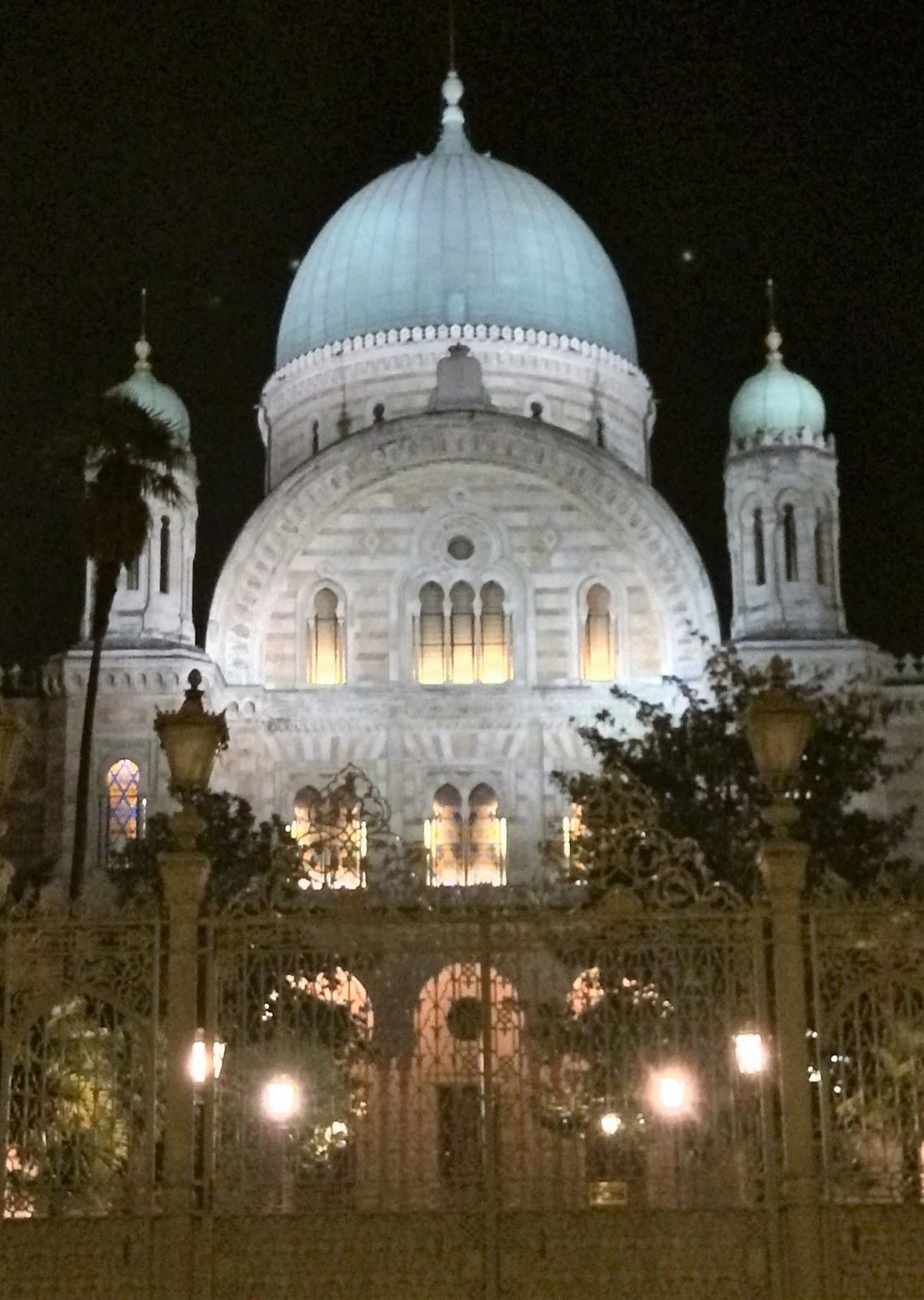
The synagogue at night.  The synagogue is near our apartment and we happened to pass by on the same day as our tour.
Florence skyline:  The Great Synagogue of Florence in the center and the bell tower of the Basilica of Santa Croce to the left
Next Up:  A fortunate occurrence.

Thursday, March 23, 2017

Random Things #9

Still more random things from Florence.

During a rainy day in Florence, pointing to the level of the 1966 flood.  Seems a bit like tempting fate.

One of the oldest buildings still standing in Florence.  Today, the tower is part of a hotel in the ancient heart of the city.  Apparently, the tower is round because its foundation was once a circular wall around a heated pool during the Roman era.  Possibly dating from the 7th century, the building is known as La Torre della Pagliazza, or the Tower of the Straw Mats.  For a time, the tower served as a prison for women, who slept on straw mats.  You can stay in a hotel suite in the tower today.  The suite costs about $2,400/night during Summer.  A straw mat is available upon request.  

A bronze 3D map of Florence in a main square

Meet the Glutton, a trash eating monster. It really sucks.

Wednesday, March 22, 2017

Street Art: Florence #5

Clet Abraham is a prominent street artist.  He is known for augmenting road signs with his art.  Here is an example around the corner from our apartment.

A No Entry road sign with art by Clet Abraham 
Clet Abraham is 50 year old French artist living in Florence.  Known as CLET (pronounced like "clay" in English), the artist has modified road signs all over Florence and apparently in many other cities in Italy and beyond--Rome, Milan, London, Paris, Valencia etc. 

Creating road sign art is sort of like threading a needle.  The sign's readability should be preserved.  No one wants to cause a car crash.  The artistic message should have meaning and should relate to the significance of the sign being modified.   After seeing many different CLET road signs around Florence, we think most of the signs thread that needle.     

Recently, we visited his studio in the hipster trendy San Niccolò neighborhood of Florence, together with visitors Sally and Rob, Susan's sister and brother-in-law.  CLET's art extends beyond modified road signs.  The studio has many original works on display, along with postcards and stickers for purchase.  During our visit, we saw CLET himself hard at work on a new creation.  CLET's studio is worth a visit. 

Below are some CLET works of art from his studio and the streets of Florence.


CLET goes blub

Rob, Sally and Susan, at CLET's studio

A random dude and hottie at CLET's studio

Tuesday, March 21, 2017

Random Things #8

Some more random things from Florence.
The Palazzo Vecchio on a nice day in Winter

An old well, complete with chain, pulley and buckets, in the 15th century Villa Antinori

Mr. Clean's Italian cousin, Mastro Lindo

 Italian brandy (grappa) in a telephone shaped container, with drinking glasses to boot.  Very creative. 

Monday, March 20, 2017

Museums: Ferragamo (Part 2 of 2)

The exhibition at the Ferragamo Museum has some truly unique fashions.  Here is a sampling of what we saw.

Fashion is not about seeing where you are going: 


We dubbed this outfit "The Hot Pad Dress"


Seinfeld-esque Fashion:   If Seinfeld's Kramer can create a coffee table book that turns into a coffee table, why can't a fashion designer create a coffee table that turns into a woman's skirt?  Concentric wooden hoops transform from a circular coffee table into a full length skirt.  Click here to see it for your self.  We think Kramer would be pleased.   


Remote Control Fashion:  The dress pictured below has moveable parts that are remotely controlled.  To see the dress in action, click here.   


Eliminating the Catwalk:  Fashion models typically glide down a runway to display new fashions.  One designer asked, "What if we substitute a canal for the catwalk?"  Check out the answer in the photos below.  The models actually floated down a canal where the designer's new fashions.  We wonder if the clothes were waterproof. 


Mood Board:  The exhibition included a unique display.  In a separate room, there was a video mood board.  As part of the creative process, some fashion designers collect objects and photos and affix them to a large board or a wall.  The board captures a style or mood they are creating, hence the name "mood board".  The museum created a virtual a mood board using a video display in the round, together with music to help set the mood.  Check it out here.


Shoes:  What would an exhibition at the Ferragamo Museum be without shoes, lots of shoes?

A large collection of Ferragamo footwear over the decades

Apparently, the shoes are waterproof.

A shoe with a clear plastic sole

A large collection of shoe lasts autographed by famous customers

Michael Jordan has some big dogs.

Some fashionable hottie at the Ferragamo Museum
Since Susan loves shoes, she enjoyed touring the Ferragamo Museum.  A return visit is a safe bet.