Saturday, July 7, 2018

Where do you live in D.C.? #15 (Part 1 of 2)

Where do we live in D.C.?

We live 3 blocks from Washington Circle, one of the many circles that dot the traffic landscape of D.C.

Circles are one of the features of the original plan for the city created in 1791 by French officer, engineer and artist Pierre L'Enfant.  L'Enfant modeled According to the National Park Service:  "L'Enfant developed a Baroque plan that features ceremonial spaces and grand radial avenues, while respecting natural contours of the land. The result was a system of intersecting diagonal avenues superimposed over a grid system."  An image of the 1791 plan appears below.


L'Enfant's plan provided that streets would be laid out in a north/south-east/west grid.  Broader avenues diagonally crossed the streets of the grid and intersected streets at circles and squares.  The circles and squares on L'Enfant's plan were intended to be parks and ceremonial places for statues and public events.  

Washington Circle was an unnamed circle on L’Enfant’s 1791 plan.  In the image below, the red arrow marks Washington Circle at the intersection of K and 23rd Streets, Northwest, and Pennsylvania and New Hampshire avenues.


So, how did the unnamed circle become Washington Circle?

Next Up:  General Washington arrives 77 years late.

Friday, July 6, 2018

Museums: National Gallery of Art #13

We recently revisited the East Building of the National Gallery of Art.  

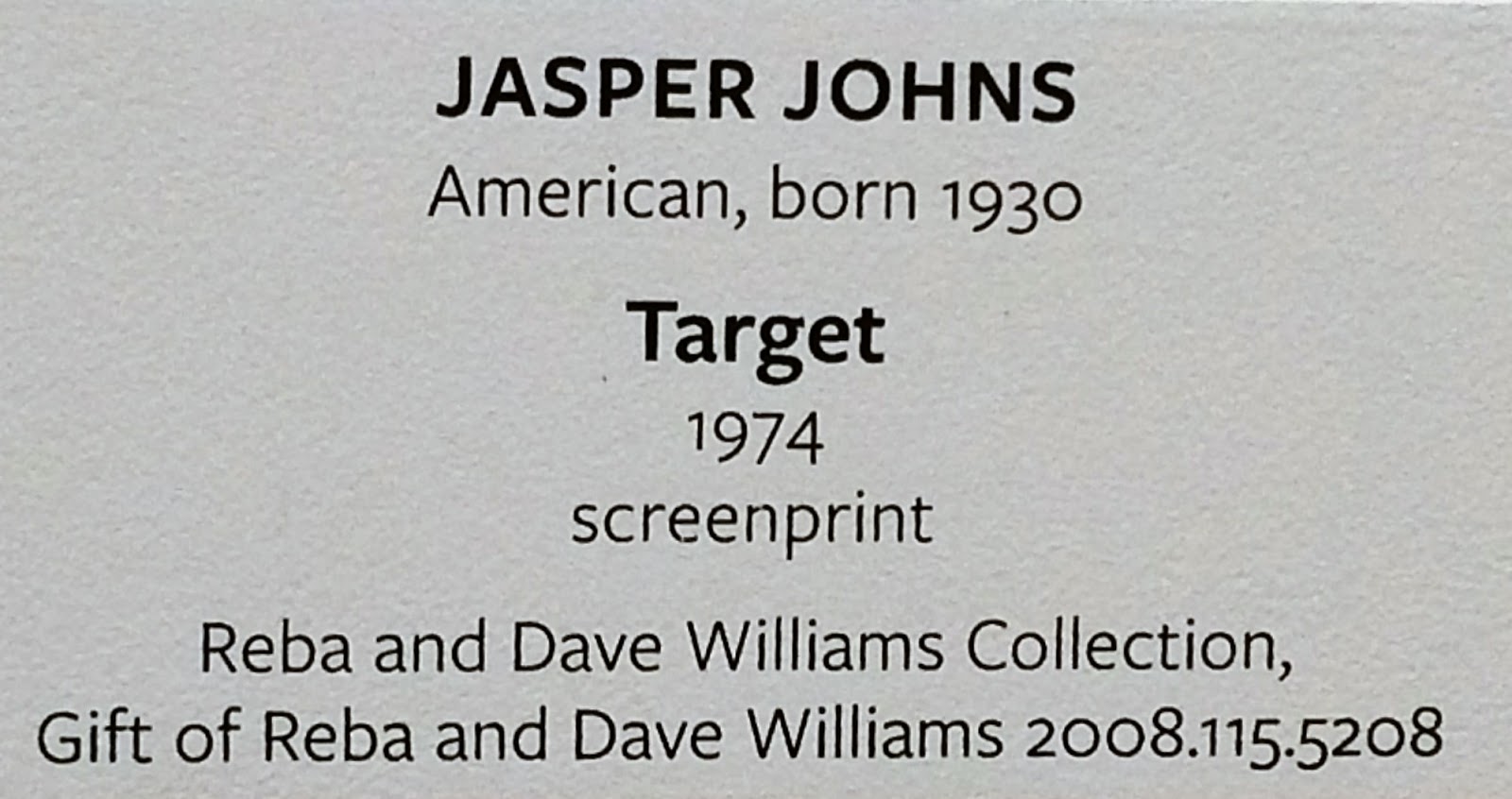
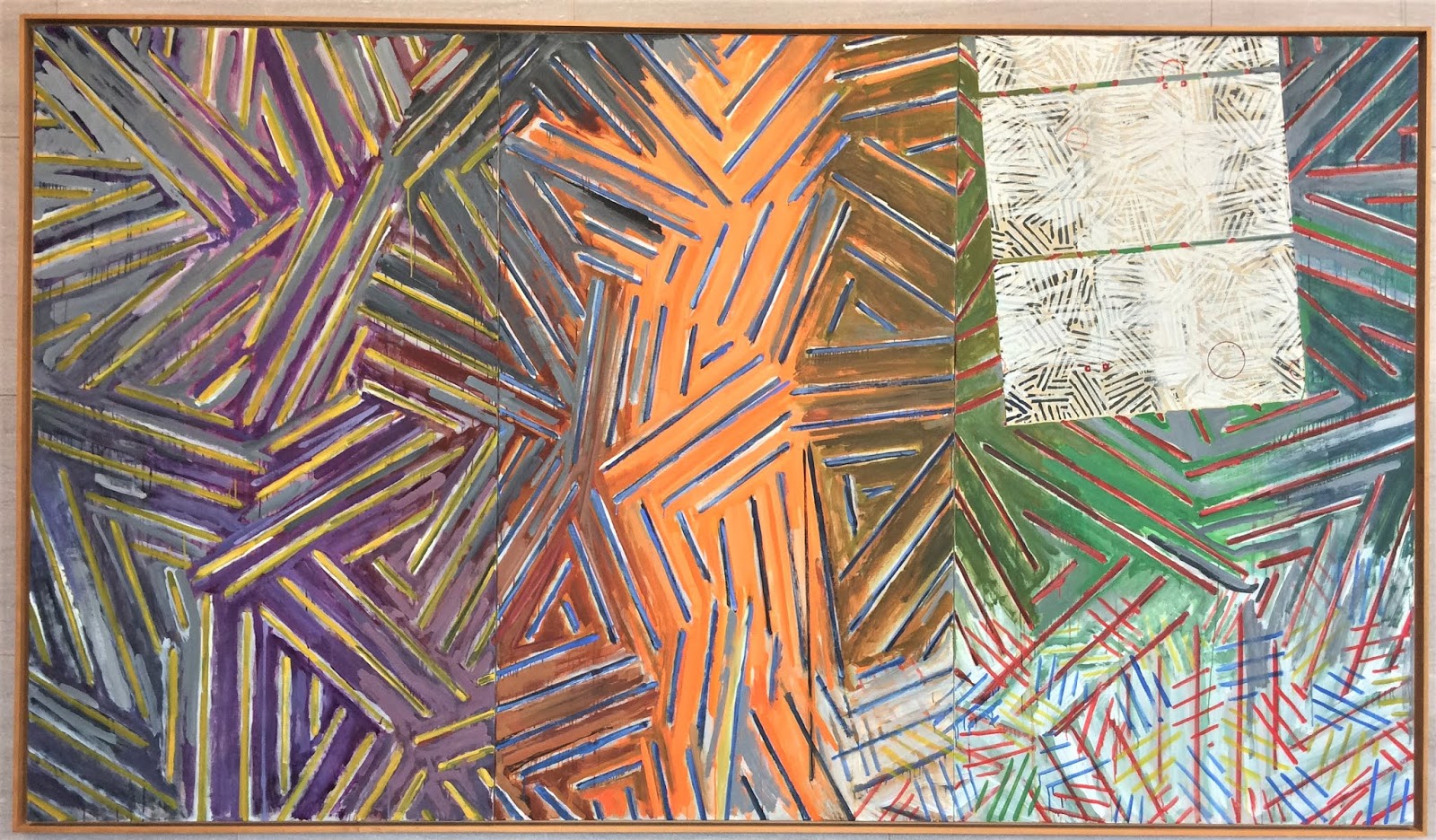
While strolling through one of the galleries, Greg noticed a set of paintings by Jasper Johns (b. 1930).  According to Getty.edu: Johns is an "American painter, sculptor, and printmaker who was one of the leaders of the Pop Art movement of the late 1950s and early 1960s. He is best known for his images of targets, flags, maps, and other instantly recognizable subjects. Although he attended the University of South Carolina for over a year and later briefly attended an art school in New York, Johns is largely considered a self-taught artist."  Johns has received a National Medal of Arts (1990) and a Presidential Medal of Freedom (2011).

Below are photos of the paintings on display.  You can judge for yourself whether Johns is "America's foremost living artist" (according to a recent New York Times article).


So, is Jasper Johns America's greatest living artist?   If not Johns, then who?

Thanks for revisiting the National Gallery of Art with us.

P.S.  Greg wonders whether the good people at Target were inspired by a Jasper Johns painting, when they created their logo in 1962.  After all, Johns is considered part of the Pop Art movement.  Who knows? 

The original Target logo (1962)


Thursday, July 5, 2018

Museums: The National Zoo (Part 2 of 2)

And now for some potty humor.  (If you are a frequent reader of this blog, you know that potty humor is a periodic topic.  Enjoy!)

Apparently, the fine folks at the National Zoo have a healthy sense of humor.  They think, "You don't know POOP!"

In the restrooms at the National Zoo, you can learn some additional fun facts about the animals living at the zoo.  Appropriately, the fun facts relate to the animals' bodily functions.  Check it out.  


A perfume room.  Who knew?

Thanks for visiting the National Zoo with us.  

Wednesday, July 4, 2018

Museums: The National Zoo (Part 1 of 2)

The National Zoological Park, or the National Zoo, is one of the oldest zoos in the United States, founded nearly 130 years ago in 1889.  (The National Zoo is part of the Smithsonian Institution, which makes it a museum of sorts, a museum of animals and plants.)

We visited the National Zoo with daughter Sally. It turns out that she is a big zoo fan. So, we spent the better part of a day visiting all parts of the zoo, even the dreaded Reptile Discovery Center.  Susan suppressed her mortal fear of snakes and ventured inside.

The National Zoo is famous for its giant pandas from China.  


The first two arrived in 1972 and pandas have been there since then.  Today's residents are Tian Tian and Mei Xiang, who gave birth to Bei Bei.  When we visited, the pandas were locked inside--two of them due to the extreme heat and one (Mei Xiang) because she might be pregnant. Apparently, it is hard to tell whether a female giant panda is pregnant because the symptoms of pregnancy and pseudo-pregnancy are similar.  

Fortunately, panda cams allowed us to view the pandas remotely.  You can look in on Mei Xiang by clicking here.

Plus, Sally and Susan were able to get up close and personal with a colorful replica panda (pictured below).


Here is a photographic safari of our visit to the National Zoo.  Enjoy!


A Sand Cat resting in a pen

An Orangutan playing with a paintbrush

A lounging Gorilla
A baby Orangutan playing with a ball


Two necking turtles

A resting Lemur - what we wanted to do after braving the heat of the Zoo

A family of Meerkats
Next Up:  Potty Humor

Tuesday, July 3, 2018

Sports in D.C.: The Washington Capitals, the 2018 Stanley Cup Champions

D.C.'s main professional sport is politics.  

All other major professional sports are represented in D.C., including the NHL.  Born in 1974, the Washington Capitals franchise has fielded some great teams over the last 44 years.  The Caps, however, never had what it takes to win the Stanley Cup.  Until this year.  


We have followed the Caps since arriving in D.C. and attended some games, including a playoff game.  As the Caps kept winning and advancing in the playoffs, the DMV's mania for the Caps grew.  In the end, the Caps prevailed and won the championship.

A few days later, D.C. hosted a victory parade with tens of thousands of attendees.  Here are some photos from the event.

Team members aboard a double-checker bus respond to cheering crowds

Some random hottie shows her Capitals pride.

A view of the jumbotron, the stage in the distance and the Capitol in the background

One of the team favorites is #8 Alexander Ovechkin

"Ovi" hoisting the Stanley Cup

Monday, July 2, 2018

Films in D.C. #2

Ocean's 8?

Shouldn't it be called Ocean's 9?


Some random hottie crashed the party.  A good time was had by all.

Sunday, July 1, 2018

Monuments: Union Station (Part 3 of 3)

Our tour of Union Station continues.  

Pop Quiz:  What do Gene Wilder and Richard Pryor have in common with Union Station?

Answer:  They starred in the 1976 film Silver Streak, the ending of which was supposedly based on an actual event at Union Station in 1953.

"On January 14th, 1953, the overnight Federal Express No. 173 departed Boston at 11:00 p.m. carrying both passengers and mail en route to Washington D.C.  The engineer reported trouble with the air brakes about 45 minutes later, and an inspection was carried out during the New Your City stop, though no problems were discovered. The Federal Express departed New York City at 4:38 a.m., continuing to Philadelphia, Wilmington, and Baltimore, and departed from Baltimore at 7:50 a.m. for the last stop at Union Station."

"The train accelerated to 80 mph (normal speed) until reaching Landover, Maryland, when the engineer attempted to apply the brakes and start slowing for the approach to Washington D.C.  The regular brakes only slowed the train to 60 mph, and emergency brakes applied moments later brought it down to 50 mph.  The engineer then tried to throw the train into reverse, but the stress caused the electric engine to spark and malfunction.  As the train began the final descent into the city, a grade change caused the Federal Express to pick up speed.  Finally, the engineer sounded the distress signal, and began running through the cars telling passengers to get down and brace.  The signal worker in the yard quickly directed the train onto track 16 and phoned the stationmaster’s office to warn them of the approaching train, supposedly shouting “Runaway on track 16! Run for your lives!”  Twenty seconds later, the Federal Express barreled through the stationmaster’s office at 45 miles per hour, just barely missing the fleeing master and his staff."


"The Federal Express struck the bumper at the end of the track bed going 35 mph and crashed through the bumper, offices, a newsstand, and finally into the concourse itself.  The concourse floor gave way beneath the 240-ton locomotive, and the engine plunged into the mail level below . . . , coming to rest 6 inches from the foundation of the Main Waiting Room beyond."

"Incredibly, no one died or was even seriously injured in the crash, and train service was delayed but not suspended." 

The Federal Express resting in the Main Concourse, after crashing and falling through the floor.

A view of the Federal Express in the basement under the Main Concourse.
Passenger cars of the Federal Express
A random hottie hangs at Track 16, the site of the Federal Express train wreck

“Runaway on track 16! Run for your lives!”
So, what happened at the end of the film Silver Streak?  A runaway train crashes into a station.

Scene from Silver Streak.  Note the smile on the front of train.    
Thanks for touring Union Station with us.  And remember--train travel is still much safer than driving.